Restaurant Business Success Series | Blog #8
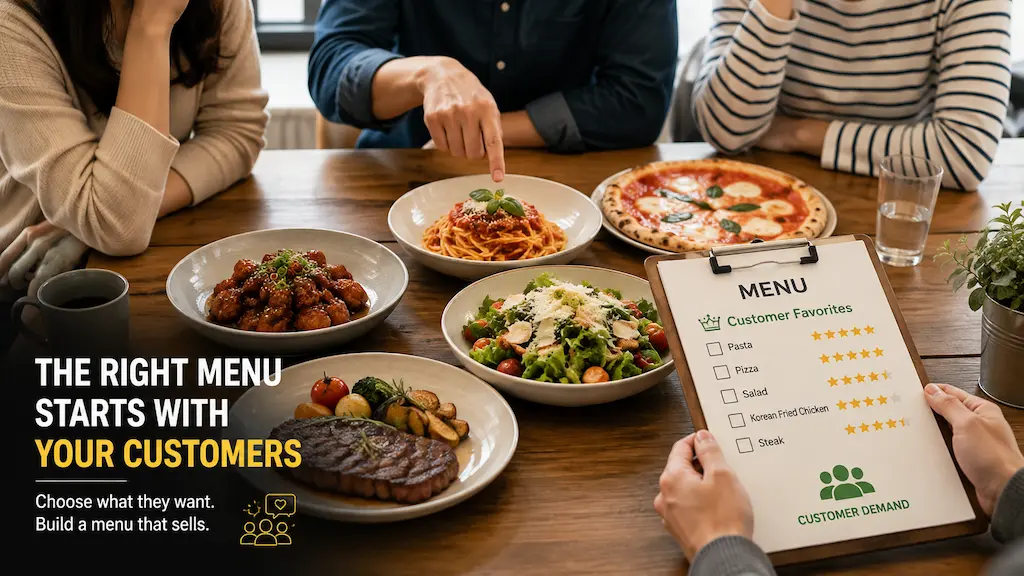
The best restaurant menu is not the one you cook best. It is the one your customers want to buy
Introduction
Many first-time restaurant owners choose their menus based on the dishes they love or know how to prepare best.
I once believed something similar.
After nearly 20 years of opening and operating restaurants in Greater Vancouver, I have learned that cooking skills and confidence are important, but they are not enough.
A menu that succeeds in one location may struggle in another, even when the recipes, ingredients, and cooking methods remain unchanged.
Different locations attract different customers, with different tastes, budgets, and dining expectations.
The real challenge is not simply creating a good menu. It is developing the right menu for the customers who actually visit your restaurant
Success Does Not Automatically Transfer
In Blog #2, I shared how I opened a second restaurant using essentially the same menu that had worked successfully at my first location.
I was confident because the food had already proven popular.
Unfortunately, I underestimated how different the customers would be. Their spending habits, dining preferences, and expectations did not match those of my original customers.
Eventually, I had to sell the restaurant.
That experience changed my approach to menu development.
A successful menu cannot simply be transferred from one location to another. It must fit the customers at each location.
Start With What You Know Best
Although customer demand should guide menu selection, I do not believe restaurant owners should begin with unfamiliar dishes simply because they appear popular.
My approach has been to start with the dishes we know how to prepare best.
These are menu items we understand well, can produce consistently, and have confidence in serving.
Starting with familiar dishes helps employees maintain consistent taste and portion sizes. It also improves kitchen efficiency and establishes a clear food identity.
However, there is one important condition.
The initial menu is a starting point, not a permanent decision.
Once the restaurant begins operating, actual customer behavior must help determine which dishes deserve to remain.
Observe Customer Demand During the First One or Two Months
One of the most practical lessons I have learned is the importance of observing customer orders during the early stage of operation.
After introducing our initial menu at a particular location, I generally allow approximately one or two months to understand how customers respond.
During this period, I pay close attention to which dishes customers order frequently and which receive relatively little interest.
I also consider the characteristics of the location.
Customers may differ in how much they are willing to spend, how quickly they need their meals, and what flavors they prefer.
A menu item that performs well at one restaurant may attract little interest at another.
Rather than assuming customers will eventually change their preferences, restaurant owners should respond to what actual sales reveal.
Customer orders are more reliable than an owner’s personal confidence.
Remove Weak Menu Items and Strengthen Popular Ones
After observing sales for one or two months, I review the menu carefully.
If certain dishes consistently receive relatively few orders, I am willing to remove them.
This does not mean those dishes are bad. They may simply be unsuitable for that particular customer group.
Keeping too many slow-selling items also creates operational problems. Additional ingredients increase inventory requirements, preparation becomes more complicated, and employees must maintain dishes that customers rarely order.
Instead of protecting every original menu item, I concentrate on the dishes customers genuinely enjoy.
When a particular menu category receives a strong response, I consider expanding it with similar dishes.
This allows the menu to develop around demonstrated customer demand rather than personal assumptions.
The goal is not to offer more choices. It is to offer more of the choices customers actually want.
Test New Dishes Through Today’s Specials
Removing weak menu items is only one part of menu development. Restaurants must also explore new opportunities.
However, introducing an unfamiliar dish directly into the permanent menu can create unnecessary risk.
My preferred approach is to begin with a Today’s Special.
This allows us to introduce a new dish on a limited basis before committing to it as a regular menu item.
Before selecting a new dish, I consider the location’s customer characteristics, food preferences, and acceptable price range.
A dish may taste excellent, but if its price exceeds what customers are willing to pay, it may struggle. The same applies when preparation takes too long for a location where customers expect quick service.
Offering the dish as a special allows us to observe genuine customer interest while checking whether the kitchen can prepare it efficiently and consistently.
It is a more practical approach than adding permanent menu items based only on the owner’s enthusiasm.
Let Customers Taste and Evaluate New Menu Items
Customer feedback is an important part of my menu development process.
When testing a new dish, I sometimes offer customers a sample and ask for their opinions.
I want to know whether they enjoy the taste, whether the dish suits their preferences, and whether they would consider ordering it.
Customers may appreciate the flavor but suggest adjustments to the portion, ingredients, or price.
These reactions deserve serious consideration.
However, one positive comment is not enough to justify adding a dish permanently.
I look for consistently favorable feedback together with encouraging customer orders.
A successful menu test requires more than compliments. Customers must also be willing to buy the dish.
When the response remains positive, I consider adding the new dish to the regular menu and removing an existing underperforming item.
This keeps the menu focused while allowing it to improve.
A Practical Menu Development Cycle
Based on my operating experience, I follow six steps:
1. Start with proven dishes.
Choose menu items the kitchen can prepare confidently and consistently.
2. Observe customer orders for one or two months.
Identify popular dishes and those receiving relatively little interest.
3. Review customer characteristics and pricing.
Consider local preferences, spending habits, convenience, and price expectations.
4. Remove weak items and expand successful categories.
Replace consistently unpopular dishes while developing options similar to proven favorites.
5. Introduce new dishes as Today’s Specials.
Offer samples when appropriate, collect customer feedback, and monitor actual orders.
6. Add successful specials to the permanent menu.
When customer response and sales remain favorable, replace an underperforming item with the new dish.
This process allows the menu to improve without becoming unnecessarily large or complicated.

Keep Your Restaurant’s Identity While Listening to Customers
Adapting a menu to customer demand does not mean abandoning the restaurant’s identity.
In my experience, restaurants need recognizable flavors and reliable quality.
Customers return because they know what to expect.
I have seen restaurants gradually change their original recipes in an effort to appeal to a wider audience.
A little more sweetness, less spice, or different ingredients may appear to be small adjustments. However, too many changes can weaken the distinctive flavors that originally attracted loyal customers.
There is an important difference between improving menu selection and changing the character of the food.
A restaurant can preserve its signature recipes while adjusting which dishes it offers at each location.
It can also introduce new dishes that complement its existing strengths.
Protect the food quality and identity that customers trust, while allowing customer demand to guide menu development.
Innovation Should Be Controlled, Not Random
Introducing new dishes can create excitement, but innovation should be managed carefully.
Every additional menu item affects purchasing, inventory, preparation, staff training, and kitchen efficiency.
A new dish should meet several conditions.
Customers should enjoy it, the price should be appropriate, and the kitchen should be able to prepare it consistently.
It should also fit the restaurant’s overall concept.
This is why I prefer testing new dishes before making them permanent.
If customer response is weak, we can reconsider the dish. If feedback and orders remain strong, we have a better reason to add it.
Good menu innovation is not about constantly adding dishes. It is about making better decisions based on customer response.
The Most Important Lesson I Learned
Looking back, one of my biggest mistakes was believing that a successful menu would succeed wherever I introduced it.
I placed too much confidence in previous success and not enough attention on the customers at the new location.
That experience changed how I make menu decisions.
The owner should provide the initial direction based on experience and cooking strengths, but customers should help shape the menu over time.
Actual orders, customer feedback, local preferences, and price expectations provide information that personal confidence cannot replace.
A menu should continue to improve as the restaurant learns more about its customers.
Final Thoughts
Choosing the right restaurant menu is not a one-time decision made before opening day.
It is an ongoing process of observation, evaluation, and improvement.
Start with the dishes you prepare well. Observe customer orders during the first one or two months. Remove consistently weak items, strengthen popular categories, and introduce new dishes carefully through Today’s Specials.
Listen to customer feedback, but also pay attention to what customers actually order.
Most importantly, maintain the food quality and identity that make your restaurant worth visiting.
The owner creates the first menu. The customers help determine the menu that succeeds.
That is one of the most valuable lessons I have learned through nearly 20 years of operating restaurants.
About the Author
The author has spent nearly 20 years opening and operating independent restaurants in Greater Vancouver, Canada. Rather than sharing theory, this blog series is based on real-world experience—successful openings, costly mistakes, operational improvements, and practical systems that help small restaurants achieve long-term success. The goal of this series is to help future restaurant owners avoid costly mistakes and make better decisions before investing their time, money, and energy.