Restaurant Business Success Series | Blog #17
Why Great Teamwork, Better Systems, and Smart Technology Create a More Productive Restaurant Kitchen
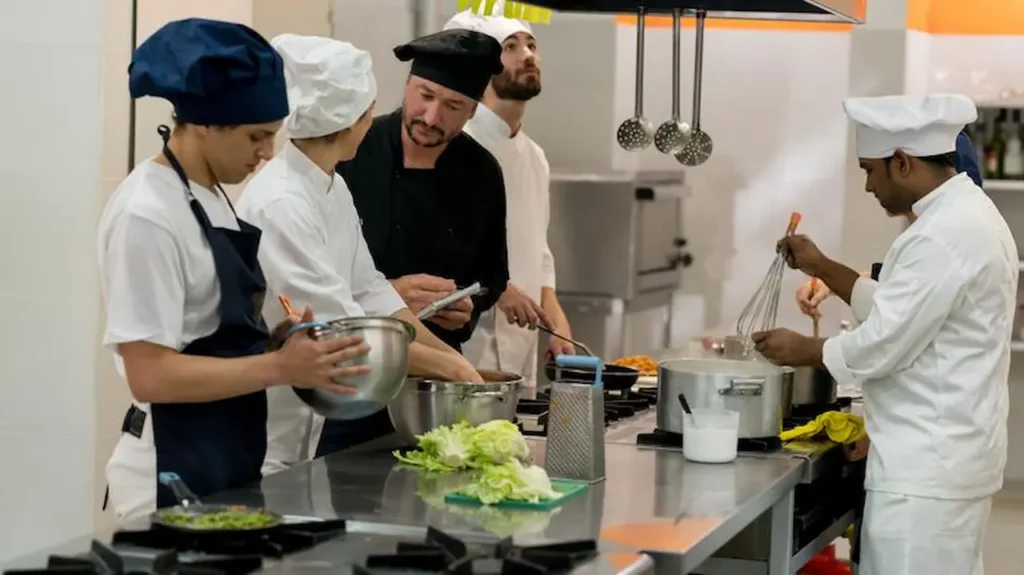
Introduction
When restaurant owners think about kitchen productivity, they often think about speed.
How can we prepare food faster? How can we serve more customers with the same number of employees? How can we reduce labor costs?
These are important questions. But after nearly 20 years of operating restaurants, I have learned that simply asking employees to work faster rarely creates a truly productive kitchen.
To me, the most important factor in kitchen productivity is teamwork.
A restaurant kitchen is operated by people. No matter how good the equipment or systems may be, productivity will suffer if employees do not communicate, cooperate, and work toward the same goal.
Great kitchen productivity begins with great teamwork.
Productivity Starts with People
Preparation, cooking, frying, grilling, plating, and cleaning are all connected. When one part slows down, the entire kitchen can slow down.
This is why having talented employees alone is not enough.
I have seen capable employees produce disappointing results when they did not work well together. I have also seen ordinary employees become an excellent team because they communicated, helped one another, and understood their responsibilities.
The difference was not simply skill.
It was teamwork and motivation.
People do the work, and motivated people usually do better work.
Build the Right Kitchen Shift
One important lesson I learned from experience is that kitchen productivity can change significantly depending on how each shift is organized.
Every employee has different strengths and weaknesses.
One person may perform especially well during a busy rush. Another may be excellent at preparation and organization. Someone else may be especially consistent with cooking, while another may communicate well and naturally coordinate the team.
I learned that simply putting good employees on the same shift did not always create the best results.
What mattered was how well their strengths complemented one another and how responsibilities were assigned.
When I began paying closer attention to each employee’s strengths, working style, and ability to work with others, I was able to organize shifts more effectively.
As a result, I often saw improvements not only in kitchen productivity but also in teamwork and employee morale.
That experience taught me an important lesson:
A productive kitchen is not just about having good employees. It is about putting the right people in the right roles and building the right team for each shift.
Motivation and Team Culture Matter
Employees who feel respected and understand their importance to the restaurant are more likely to take responsibility for their work.
They notice when ingredients are running low, help another station during a rush, communicate problems early, and care about the quality of the food leaving the kitchen.
I believe a strong restaurant team should also have something of a family atmosphere.
This does not mean working without rules or accountability. Responsibilities and standards must remain clear.
It means creating a culture where employees respect one another, help each other when necessary, and understand that everyone succeeds together.
Use Short Pre-Shift Meetings

Even a well-organized team needs good communication.
A five- or ten-minute pre-shift meeting can make a meaningful difference.
The team can quickly review expected business volume, large orders, inventory issues, individual responsibilities, and any problems that need attention.
A few minutes of communication before service can prevent much more confusion during the busiest hours.
Good communication prevents small problems from becoming big problems.
Preparation Supports Teamwork
A productive kitchen begins before the first customer arrives.
Ingredients should be prepared, sauces organized, portions measured, tools positioned, and stations properly stocked before the rush begins.
Good preparation reduces unnecessary decisions and movement during peak hours and allows the team to focus on what matters most:
Cooking consistent, high-quality food for customers.
Improve the Workflow, Not Just the Speed
A productive kitchen should be designed around efficient movement.
Are employees repeatedly walking across the kitchen for ingredients? Are frequently used tools too far from their stations? Are employees constantly crossing each other’s paths?
A few unnecessary steps may seem insignificant, but repeated hundreds of times every day, they become wasted labor.
The goal should not be to make employees move faster.
The goal should be to eliminate unnecessary movement.
Standardization Reduces Waste and Mistakes
Standard recipes and kitchen systems are also important productivity tools.
When portion sizes, cooking procedures, sauce quantities, cooking times, and plating standards are clearly defined, employees spend less time making unnecessary decisions.
Standardization reduces hesitation, mistakes, and inconsistency while making it easier for employees to help one another.
Mistakes are especially expensive.
When a dish must be remade, the restaurant loses ingredients, labor, cooking time, and customer waiting time.
The fastest kitchen is not the kitchen that rushes. It is the kitchen that gets the food right the first time.
The Next Opportunity: Kitchen Automation and Robotics
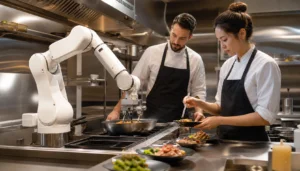
Restaurant owners should also pay close attention to kitchen automation and robotics.
Commercial kitchen technology continues to improve. Equipment and automated systems can now assist with repetitive tasks in preparation, cooking, frying, beverage preparation, dishwashing, and other areas.
This deserves attention because labor costs continue to rise while finding and retaining reliable restaurant employees can be difficult.
The right equipment or automation may reduce repetitive labor, ease staffing pressure, improve consistency, and significantly increase productivity.
However, technology should never be purchased simply because it is new.
Every investment must make economic sense.
Before investing, restaurant owners should ask three practical questions:
- How many labor hours can this equipment realistically save?
- Will it improve consistency and productivity?
- Can the investment pay for itself within a reasonable period?
If the answers are positive, the technology deserves serious consideration.
Technology Should Support the Team
The goal of automation should not simply be replacing people.
A better approach is to use technology for repetitive and predictable tasks while allowing employees to focus on areas where people provide greater value.
Technology can reduce repetitive labor. Systems can create consistency. But people still provide judgment, communication, teamwork, responsibility, and attention to quality.
The strongest kitchens of the future may not be those with the most employees or the most robots.
They may be the kitchens that find the right balance between people, systems, and technology.
Never Sacrifice Food Quality for Productivity
There is one principle that should never be forgotten.
Productivity should never come at the expense of food quality.
Preparing too much food too early, extending holding times, skipping important cooking steps, or lowering standards may save time in the short term.
But customers eventually notice the difference.
Once customers begin losing confidence in the food, the labor saved is not worth the long-term damage.
Efficiency should remove waste—not remove quality.
Final Thoughts
Increasing kitchen productivity is not about telling employees to work faster.
It begins with building the right team.
Understand each employee’s strengths, put the right people in the right roles, communicate regularly, and create shifts where employees complement and support one another.
Then strengthen that teamwork with good preparation, efficient workflow, standard recipes, and reliable kitchen systems.
As labor costs rise and technology improves, restaurant owners should also explore equipment, automation, and robotics when the investment makes economic sense.
People, systems, and technology all have an important role, but they should serve the same purpose:
To produce consistent, high-quality food with less wasted time, movement, labor, and effort.
Great kitchen productivity begins with great teamwork. Systems make the team stronger, and technology makes the system more efficient—but food quality must always come first.
About the Author
The author has spent nearly 20 years opening and operating independent restaurants in Greater Vancouver, Canada. Rather than sharing theory, this blog series is based on real-world experience—successful openings, costly mistakes, operational improvements, and practical systems that help small restaurants achieve long-term success.