Restaurant Business Success Series | Blog #21
Understanding the Difference Between a Busy Restaurant and a Profitable Restaurant
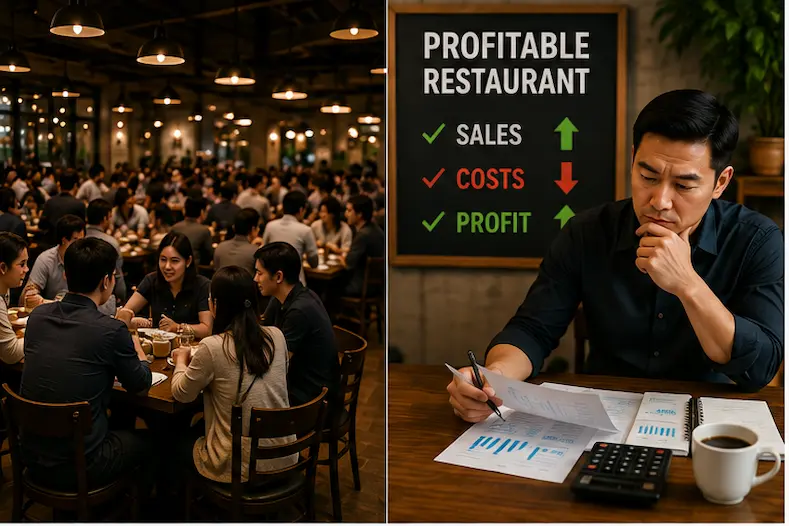
Introduction — Busy Does Not Always Mean Profitable
A restaurant full of customers may look successful. Tables are occupied, orders keep coming in, and employees are constantly busy.
But after many years of operating restaurants, I learned an important lesson:
A busy restaurant is not always a profitable restaurant.
There is an old business saying that roughly means:
A business can appear to make money in the front while losing it in the back.
Sales may look impressive, but after paying food costs, labor, rent, discounts, commissions, and other expenses, very little profit may remain.
That is why restaurant owners should ask not only, “How much did we sell?” but also, “How much did we actually keep?”
Sales and Profit Are Not the Same Thing
One of the easiest mistakes restaurant owners can make is judging success mainly by sales.
A restaurant generating $100,000 in monthly sales may sound successful, but it still has to pay for food, labor, rent, utilities, supplies, delivery commissions, maintenance, and other operating expenses.
Only after those costs are paid can we see what the business actually earned.
Revenue shows what comes in. Profit shows what remains.
Higher Sales Can Also Create Higher Costs
Higher sales are generally positive, but they often create additional costs.
More customers require more ingredients and sometimes more employees. Busy periods can create overtime, waste, and mistakes. Delivery orders may increase revenue while commissions and packaging reduce margins.
Discount promotions can also increase traffic while reducing the amount earned from each sale.
An additional dollar of revenue does not automatically create an additional dollar of profit.
The better question is:
How much profit are these additional sales actually creating?
Understand Where Every Dollar Goes
A simple way to understand restaurant profitability is to follow each dollar of sales:
Sales → Food Cost → Labor Cost → Rent → Operating Expenses → Profit
Every dollar must travel through this structure before anything becomes profit.
This is why food cost control, inventory management, standard recipes, employee productivity, quality control, and daily cost management are closely connected.
They all lead to one important question:
How much of our sales are we actually able to keep?
Profit Margin Matters More Than Sales Alone
Consider two restaurants.
Restaurant A generates $120,000 in monthly sales but keeps only $3,000 after expenses.
Restaurant B generates $90,000 but keeps $9,000.
Restaurant A has higher sales and may look more successful. But Restaurant B is financially healthier because it converts more of its sales into actual profit.
This is why profit margin matters.
Higher revenue may make a restaurant look successful. A healthy margin makes the business sustainable.
A Busy Restaurant Can Still Lose Money
Over the years, I have seen restaurants where customers kept coming and employees worked extremely hard, yet the owners struggled financially.
The problem was not always a lack of customers.
Food costs may have been too high. Labor scheduling may have been inefficient. Waste may not have been controlled. Discounts or delivery commissions may have increased sales without creating enough profit.
Everyone looked busy, and the sales report looked good.
But after everything was calculated, very little remained.
This is exactly what the old saying means: the business may appear to make money in the front while losing it in the back.
Don’t Chase Sales at Any Cost
Discount promotions are a good example of why higher sales do not always mean higher profits.
A discount can attract new customers and can be an effective marketing tool. But frequent discounting can create an unintended habit.
Customers may begin visiting mainly during promotion periods, happy hours, or seasonal discounts. The restaurant becomes busy during those times but remains quiet at normal prices.
In some cases, the promotion is simply moving existing customers from one time period to another rather than creating sustainable new business.
Worse, customers may learn to wait for the next discount.
A promotion should create future customers, not customers who only wait for the next promotion.

Why I Generally Chose a No-Discount Policy
Throughout most of my restaurant business experience, I generally maintained a no-discount policy.
Nearby restaurants sometimes offered frequent promotions, but I did not feel we needed to follow them.
Instead, we focused on food quality and customer service.
If customers believe the food, service, and overall experience are worth the price, they have a reason to return without waiting for a promotion. Our customers continued to visit even when nearby competitors offered discounts, and strong customer reviews reinforced my belief that customers recognized the value we provided.
This does not mean discounts should never be used.
On rare occasions, perhaps once every few years for a special reason, we offered a promotion. Customer traffic sometimes increased to nearly twice the normal level.
Because promotions were unusual for us, they actually felt special.
That experience taught me:
Discounting can be a useful marketing tool, but it should not become the foundation of everyday sales.
The real question after any promotion is not simply how many customers came.
It is:
Will they return when there is no discount?
Turn Sales Into Profit
In the previous article, I discussed how small daily decisions can gradually increase or reduce restaurant costs.
That is where profitability is built.
Portion control, waste reduction, inventory management, employee scheduling, standard recipes, productivity, and quality control may seem like separate issues. Together, they determine how much revenue becomes profit.
But cost control should never mean blindly reducing portions, lowering food quality, or cutting employees until customer service suffers.
Saving a few dollars in the wrong place can eventually cost much more through disappointed customers.
Good cost control protects customer value while eliminating unnecessary expenses.
The goal is not simply to spend less. The goal is to turn sales into sustainable profit.
Final Thoughts
— Revenue Gets Attention, Profit Keeps the Restaurant Alive
High sales can make a restaurant look successful, but sales alone never tell the full story.
A healthy restaurant knows how to generate revenue, control costs, and build customers who return because they value the food and service—not simply because another discount is available.
The goal is not to make your restaurant look busy.
The goal is to build a restaurant customers value and a business that remains profitable.
Sales tell you how busy your restaurant is. Profit tells you how healthy your business is.
About the Author
The author has spent nearly 20 years opening and operating independent restaurants in Greater Vancouver, Canada. Rather than sharing theory, this blog series is based on real-world experience—successful openings, costly mistakes, operational improvements, and practical systems that help small restaurants achieve long-term success.